
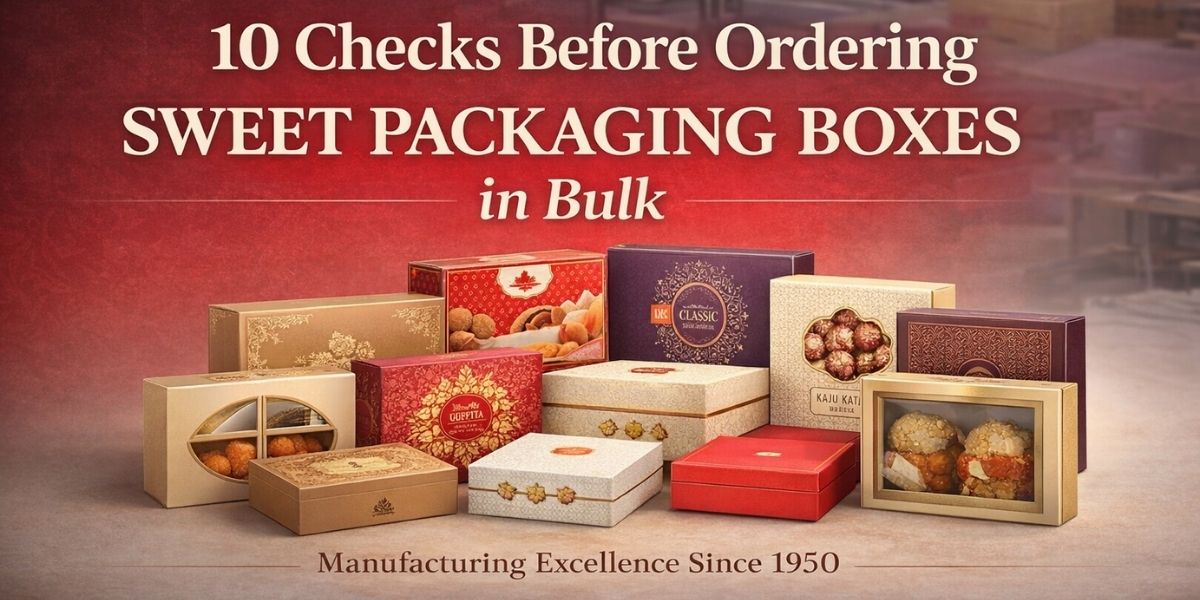
There is a moment every sweet business owner knows well.
The festival season is weeks away. Orders are coming in faster than you expected. You call your packaging supplier — and the boxes are delayed, the print is off, or worse, the sizes do not match what you ordered.
It does not matter how good your sweets are at that point. The packaging has already let you down.
Choosing a sweet packaging box wholesaler is not a decision most businesses spend enough time on. It feels straightforward until it is not. And by the time the problem surfaces, you are already mid-season with no room to fix it.
This guide exists to make sure that never happens to you.
These are not generic tips. They come from decades of working with sweet shops, mithai chains, hotels, and corporate gifting companies across India — watching what goes wrong, and understanding exactly what separates a packaging partner worth trusting from one that costs you more than money.
1. Does the Material Actually Protect the Sweet — or Just Present It?
Most buyers look at the box and ask: does it look good?
The better question is: does it work?
A sweet packaging box has one job before it has any other — keeping the sweet intact. The shape, the aroma, the moisture level, the texture. These are not small things. A customer who opens a box and finds a broken ladoo or a dry barfi does not blame the journey. They blame the brand.
Ask your wholesaler what GSM paperboard they use. Ask whether the inner surface is food-grade. Ask whether the material breathes or traps moisture. A wholesaler who cannot answer these questions confidently has not thought carefully about what they are selling you.
Good packaging protects first. It impresses second.
2. Can They Actually Do Custom — or Do They Just Say They Can?
Every packaging box wholesaler in India will tell you they offer custom sweet boxes. What they mean by that varies enormously.
Some offer customisation in the sense that they will print your logo on a standard box. That is not custom — that is branding applied to someone else’s template.
True customisation means the box is built around your product. Your sweet dimensions. Your brand colour language. Your unboxing experience. Your shelf positioning.
Before you commit, ask for samples of previous custom sweet boxes they have produced. Ask how far into the design process they go. Ask whether they produce AutoCAD layouts or structural mock-ups before production begins.
The answer will tell you immediately whether you are talking to a manufacturer or a middleman.
3. Is Their Minimum Order Quantity Built for Your Business — or Theirs?
MOQ is where many small and mid-size sweet businesses get caught.
A wholesaler with a high minimum order quantity is not a problem if you are a large mithai chain running consistent volumes. But if you are a growing business, a seasonal operation, or a boutique sweet brand, locking yourself into an order size that does not match your actual demand creates a different kind of problem — dead stock, storage pressure, and cash tied up in boxes you have not sold yet.
Ask the wholesaler what their MOQ is for standard sweet boxes and what it changes to for custom sweet boxes. Ask whether they offer tiered pricing — lower volumes at a slightly higher per-unit cost. A supplier who works with businesses at different stages of growth will have a flexible answer. One who does not will give you a take-it-or-leave-it number.
4. How Consistent Is Their Quality Across Batches?
First-order quality is easy to get right. The real test is order three, order seven, order fifteen.
Packaging inconsistency across bulk orders is one of the most common and least discussed problems in the sweet packaging industry. The colour shifts slightly between print runs. The crease lines are not in the same position. The paperboard from one batch feels slightly thinner than the last.
None of these feel catastrophic in isolation. Together, over time, they erode your brand presentation and your customer trust.
Ask the wholesaler how they ensure batch-to-batch consistency. Ask whether they retain quality samples from previous orders for reference. Ask who is responsible for quality checks before dispatch. A manufacturer with a genuine quality process will have specific, confident answers — not a vague assurance that everything is fine.
5. Do They Understand Festive Demand — or Will They Disappear When You Need Them Most?
Sweet packaging demand in India does not move in a straight line. It spikes — hard — around Diwali, Pongal, Eid, Rakhi, Christmas, and wedding season. The months before these periods are when every sweet business is placing large, time-sensitive orders simultaneously.
A wholesaler who cannot handle festive volume surge is a liability, not a partner.
Ask them directly: what is your production capacity during peak season? What is your lead time in October compared to February? Do you hold any buffer stock for repeat clients?
A packaging box wholesaler who has been in the industry long enough to have survived multiple festive cycles will know exactly how to answer this. One who hesitates is telling you something important.
6. Are the Sizes Actually Standard — or Will You Spend Half Your Time Adjusting?
Sweet boxes in India generally move in three size categories — 250 grams, 500 grams, and 1 kilogram. But what one wholesaler calls a 500-gram box and what another calls it can differ by centimetres in every dimension.
This matters more than it sounds.
If you stack boxes for retail display, a dimension inconsistency throws off the entire arrangement. If you use standardised gift bags or outer packaging, a slightly wider or taller box will not fit. If you operate multiple outlets, boxes from different production runs need to be interchangeable.
Ask for exact measurements. Do not accept approximate sizes. A professional sweet packaging box wholesaler will have a specification sheet — internal dimensions, external dimensions, depth, and closure type. If they cannot produce one, that is information too.
7. What Does Their Printing Quality Look Like Under Real Conditions?
Here is something most buyers only discover after the order arrives.
Packaging print looks different on a screen, different in a showroom sample, and different under the fluorescent lights of a retail counter or the warm light of a gift display table.
Before you approve a design for bulk production, ask for a physical proof printed on the actual material that will be used for your order. Not a digital mock-up. Not a sample printed on a different stock.
Look at the colour saturation. Look at the sharpness of fine text. Look at how the finish — matte, gloss, or soft-touch — interacts with the design. Examine the folding edges to see whether the print cracks or holds cleanly.
This single step prevents the most visible and most embarrassing quality failures in custom sweet box orders.
8. Is Their Pricing Transparent — or Will the Final Invoice Surprise You?
Wholesale pricing conversations in packaging often start with one number and end with another.
The base price is quoted. Then come the additions — plate charges for custom printing, die charges for non-standard sizes, lamination charges, packaging charges, freight charges. Each one is individually small. Together, they can move your per-unit cost significantly above what you budgeted.
Ask for an all-inclusive quotation in writing before you confirm any order. Ask specifically what is included and what is not. Ask whether tooling charges apply to repeat orders or only the first run.
A trustworthy packaging box wholesaler will welcome this conversation. One who is evasive about the full cost structure is not a supplier you want managing a bulk order under festival pressure.
9. Can They Handle Variety — or Are They a One-Product Operation?
Your sweet range is not uniform. A box for a single piece of kaju katli has different requirements than a box for an assorted 1kg mithai selection. A Diwali gift box has different requirements than an everyday retail pack.
If your wholesaler can only supply one or two standard formats, you will find yourself managing multiple suppliers — which means multiple communication threads, multiple quality standards, multiple delivery timelines, and multiple points of failure during your busiest period.
Look for a wholesaler who manufactures across folding cartons, rigid boxes, windowed boxes, and custom configurations. The depth of their range tells you how seriously they take the business of packaging — and how capable they are of growing with your product line.
10. What Happens When Something Goes Wrong?
This is the question most buyers forget to ask — and the one that matters most.
A misprinted batch. A delayed shipment. A size discrepancy discovered on arrival. These things happen in manufacturing. What separates a reliable supplier from an unreliable one is not whether problems occur — it is how quickly and honestly they are resolved.
Ask the wholesaler what their process is for handling quality complaints. Ask whether they have a replacement or credit policy. Ask who you speak to — and how fast you can reach them — if something arrives wrong three days before a major order needs to go out.
The quality of their answer to this question will tell you more about the actual experience of working with them than any sample box or price list ever could.
The Right Wholesaler Feels Like a Partner, Not a Vendor
When you find a sweet packaging box wholesaler who answers every one of these questions with confidence, specificity, and without hesitation — you have found something worth holding on to.
Packaging is not a commodity in the sweet business. It is the first thing a customer sees, the last thing they remember, and often the reason they come back. The wholesaler behind it deserves the same scrutiny you give to your ingredients, your recipes, and your people.
At The Gupta Printers, we have been manufacturing sweet boxes, custom sweet boxes, and complete packaging solutions from Sivakasi since 1950. Every question in this list is one we welcome — because we have spent decades making sure we can answer all of them.
If you are planning a bulk order of sweet packaging boxes and want to work with a team that takes your packaging as seriously as you take your sweets — we are ready to talk.
Request a sample or get a bulk quote today.
📞 +91 87540 27018
🌐 theguptaprinters.com/products/sweet-boxes/
FAQs
1. What should I check first before ordering sweet packaging boxes in bulk?
Always verify the material quality and food-grade safety of the box before anything else.
2. Do sweet packaging box wholesalers in India offer custom sweet boxes?
Yes, but always ask for a physical sample before confirming any custom bulk order.
3. What is the standard size for sweet boxes in India?
Sweet boxes are commonly available in 250 grams, 500 grams, and 1 kilogram capacities.
4. How do I ensure consistent quality across bulk sweet box orders?
Ask your wholesaler for a written quality specification sheet and batch-wise inspection reports.
5. What is a reasonable lead time when ordering sweet packaging boxes in bulk?
A reliable packaging box wholesaler typically dispatches bulk orders within 7 to 10 working days.
