
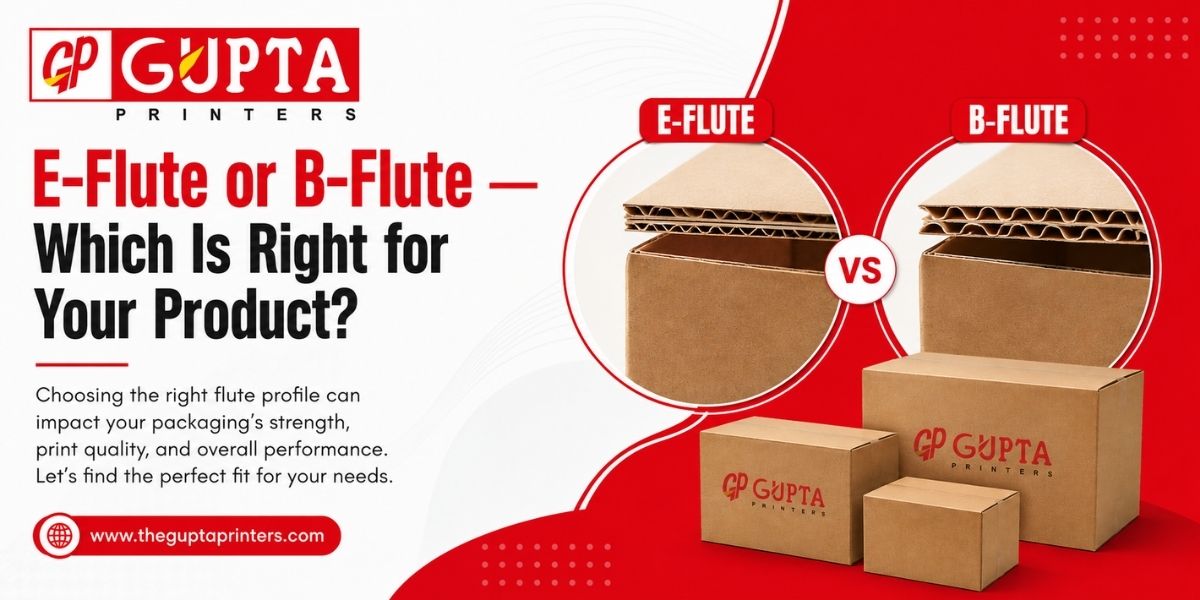
If you have been ordering corrugated boxes for a while, you already know that flute type is not a minor specification. It determines how your box performs on the production line, how it holds up in transit, and whether the print finish on the outer surface meets your brand standards.
The question is rarely “what is E-flute” — it is “which one makes more sense for what I am shipping.”
This guide is written for that decision.
The Difference That Actually Matters on the Floor
Both E-flute and B-flute are single-wall corrugated structures. The flute sits between two flat liner sheets and gives the box its strength. What changes between the two is the size of those waves — and that single difference cascades into everything else.
E-flute runs at roughly 90 flutes per linear foot. B-flute runs at about 47. E-flute is thinner (approximately 1.5 mm). B-flute is thicker (approximately 3 mm).
Thinner does not mean weaker across the board. It means the strength is delivered differently.
| Parameter | E-Flute | B-Flute |
| Thickness | ~1.5 mm | ~3 mm |
| Flutes per foot | ~90 | ~47 |
| Surface smoothness | High | Moderate |
| Print quality | Excellent | Good |
| Crush resistance | Good | Very Good |
| Puncture resistance | Moderate | High |
| Stacking strength | Moderate | High |
| Storage footprint (flat) | Compact | Bulkier |
| Weight | Lighter | Heavier |
| Best for | Retail, display, cosmetics, food cartons | Transit, heavy goods, industrial |
When E-Flute Is the Right Call
E-flute’s surface is tight and smooth. That matters the moment print quality enters the conversation — and for most consumer-facing packaging, it always does.
Garment packaging. Saree boxes, shirt boxes, innerwear packaging — these are not just containers. They are the first physical interaction a customer has with the brand. A slightly rough surface from B-flute shows through the print. E-flute gives you sharp edges, clean colour laydown, and a finish that reads as premium even at mid-range price points.
Food and bakery. Cake boxes, pastry boxes, sweet packaging — the structural demand is low, but visual appeal and moisture management matter. E-flute’s tighter construction handles short-duration moisture exposure better than B-flute because there is less air gap for humidity to settle. For ice cream boxes where the box goes through temperature transitions, E-flute with the right liner spec performs reliably.
Cosmetics and personal care. Cosmetic boxes, soap boxes, perfume packaging — this is where the brand mark lives. Met-pet printing over E-flute produces a finish that is difficult to match on B-flute without additional lamination cost. The smooth surface also takes die-cutting more precisely, which matters when your box has a window cut or a shaped tuck flap.
Pharma. Pharmaceutical packaging is regulated, but the structural requirement at unit carton level is modest. E-flute handles the rigidity and print clarity that pharma mono cartons need without adding bulk.
Pizza boxes. Flat food packaging benefits from E-flute’s surface consistency and the relatively short distance the product travels before consumption.
“We moved from B-flute to E-flute on our cosmetic line three years ago. The cost per unit barely shifted, but the print rejection rate on our offset run dropped significantly. The surface just behaves better.” — Packaging manager, personal care brand (South India)
When B-Flute Is the Right Call
B-flute earns its place when the box has to take a beating.
Electronics. An electronics box faces multiple handling events — warehouse stacking, courier transit, last-mile delivery. The thicker flute absorbs puncture force and holds its shape under compression. If you are shipping units with corners, edges, or screens, B-flute gives you a buffer that E-flute cannot reliably provide.
Liquor packaging. Glass bottles are heavy and fragile. The box needs to carry weight without the bottom flap giving out and resist lateral impact if the carton is dropped. B-flute’s stacking strength and puncture resistance make it the structurally correct choice here.
Fireworks. Fireworks packaging has specific safety and handling requirements. Robust outer shells with reliable crush resistance are non-negotiable. B-flute, often doubled into B/C or B/B configurations for heavy stock, is the standard.
Industrial and bulk. If your product is going into secondary or tertiary packaging — outer cartons that carry multiple inner units — B-flute or heavier combined flutes are appropriate.
The Cases Where People Get It Wrong
Choosing B-flute for garment boxes because it “feels sturdier.”
Sarees, shirts, and garments do not need puncture resistance. They need a box that presents well, folds cleanly on automated packing lines, and stores flat without taking up half the warehouse. B-flute adds board thickness that does nothing for garment safety but increases your per-unit cost and storage footprint. E-flute is the correct choice here in most production setups.
Choosing E-flute for heavy transit without checking the liner GSM.
E-flute’s limitation is not the flute — it is that a thin board with a light liner will fail under stacking load. If you are using E-flute for a heavier product, the liner specification (kraft GSM) matters as much as the flute. Specify this with your box manufacturer before finalising the design.
Assuming the same flute works across your entire product range.
A packaging supplier that gives you one answer for all products without asking about transit distance, stacking weight, print finish, and product category is not giving you a considered recommendation.
How to Decide: The Right Questions to Ask
Before you finalise your flute type with your box manufacturer, run through these:
- What is the primary function of the box — retail presentation or transit protection? Retail presentation favours E-flute. Transit protection favours B-flute.
- Does the outer surface carry print, lamination, or finishing? If yes, E-flute will almost always give you better results per rupee.
- What is the product weight, and how many units will stack in transit? Light to medium weight, low stack height — E-flute handles it. Heavy product, tall pallet stack — B-flute or combined flute.
- What is your storage setup? If flat-pack storage space is limited, E-flute’s compact footprint is a practical advantage.
- Is the box seen by the end customer or only by the warehouse? Consumer-facing — E-flute. Warehouse-only — B-flute is fine.
A Note on Combined Flutes
For products that sit between categories — a premium liquor gift box that needs both display quality and structural strength — the answer is sometimes neither E alone nor B alone, but a combined wall (EB or BC flute). This gives you the smooth printing surface of the fine flute on the outside and the structural depth of the coarser flute on the inside.
This is a more expensive specification but the correct one for certain product types. It is worth raising with your manufacturer if you are finding that single-wall boxes are failing on either the print or the structural side.
What This Means for Multi-Product Operations
If your business runs across categories — garments, food, cosmetics, and industrial — you likely need both flute types in your packaging lineup, and possibly combined configurations for specific SKUs.
The mistake most brands make is standardising on one flute to simplify procurement, then compensating for the mismatch with overspecified liners, which adds cost without solving the actual problem.
A manufacturer with experience across product categories can help you map flute specifications to your SKU range and identify where consolidation is genuinely possible versus where it will cost you.
Working with a Box Manufacturer Who Understands the Difference
Flute selection is upstream of everything else in the packaging process. Get it wrong and no amount of good design, printing, or lamination fully compensates.
At The Gupta Printers, Sivakasi — with over 75 years of production experience across garments, food, pharma, cosmetics, fireworks, and electronics packaging — flute specification is part of the brief, not an afterthought. Whether you need E-flute mono cartons with met-pet finishing for a cosmetics range or B-flute transit boxes for a liquor brand, the recommendation comes from what the product actually needs, not what is easiest to produce.
If you are reviewing your current packaging specifications or planning a new product launch and want a recommendation from a manufacturer who has seen most of the problems already, reach out directly.
📞 +91 87540 27018 | +91 94433 21753 📧 support@guptaprinters.net.in 📍 901, Gnanagiri Rd, Sivakasi, Tamil Nadu 626 189
FAQs
- Is E-flute more expensive than B-flute?
Not necessarily. E-flute uses less material by volume, which can offset the cost difference. The final price depends on liner GSM, print specification, and order quantity. For retail packaging at standard MOQs, E-flute is often comparable to or cheaper than B-flute for the same finished box size. - Can E-flute handle heavy products?
With the right liner GSM specification, yes — up to a point. For products above approximately 5 kg per unit or tall stacking configurations, B-flute or combined flute is a safer choice. Discuss your product weight and transit conditions with your manufacturer before deciding. - What flute is used for saree boxes?
E-flute is standard for saree boxes. The smooth surface supports high-quality print and lamination finishes, and the compact board thickness keeps the box elegant without unnecessary bulk. - What flute type is used for pharmaceutical boxes?
Most pharmaceutical unit cartons use E-flute or a lighter corrugated equivalent. The structural requirement at carton level is modest; the priority is print accuracy for regulatory text and a consistent fold line for automated packing. - Can I get samples before placing a bulk order?
Yes. Any credible corrugated box manufacturer should be able to provide pre-production samples in both flute types for comparison before you commit to a bulk run.
