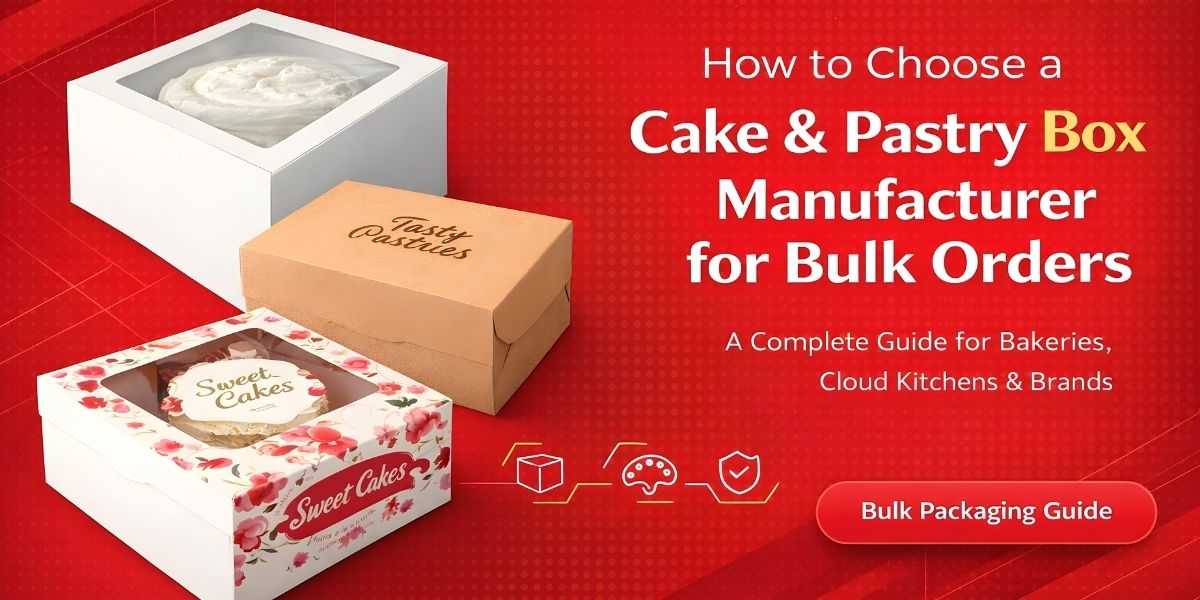
A cake arrives at a birthday table inside a box. Before anyone tastes a single crumb, that box has already said something — about care, about quality, about the bakery behind the gift. The right packaging doesn’t whisper; it announces.
But for bakery owners, café chains, cloud kitchens, and confectionery brands ordering in bulk, getting to the right box starts much earlier — it starts with choosing the right manufacturer. And that decision is rarely as simple as picking the cheapest quote.
This guide breaks down every factor that actually matters when evaluating a cake and pastry box manufacturer for bulk orders — from food-grade certifications and GSM specifications to turnaround reliability and customisation depth. Whether you’re sourcing from India, the UAE, the UK, the US, or anywhere else in the world, these principles apply universally.
| Quick answer: The right cake and pastry box manufacturer balances food-safe materials, print quality, consistent supply for bulk runs, customisation flexibility, and pricing that doesn’t punish scale. |
1. Why Your Box Manufacturer Choice Is a Business Decision, Not Just a Packaging Purchase
Most bakery owners approach packaging as an afterthought — something to sort out after the recipe, the branding, the pricing. That thinking is expensive.
When you’re ordering cake boxes or pastry boxes in bulk — we’re talking hundreds or thousands of units — a single poor batch can mean collapsed boxes on delivery, ink bleed staining cream frosting, or structural failure mid-transit. The cost isn’t just the replacement packaging. It’s the returned orders, the social media post from a disappointed customer, and the reputation repair that follows.
So the manufacturer you choose is, in effect, a silent partner in your customer experience. Treat the evaluation accordingly.
What bulk ordering actually means in packaging
There’s no universal definition of “bulk” in the box manufacturing world. Some manufacturers define it as 500 units; others won’t open a production run below 5,000. Understanding your own volume needs — and projecting three to six months ahead — will immediately narrow your shortlist.
- Small bakeries and home bakers: 200–500 units per run
- Growing café chains and cloud kitchens: 1,000–5,000 units per run
- Established confectionery brands: 5,000–50,000+ units per run
A manufacturer who handles large-format industrial runs may not give your 500-unit order the attention it deserves. A boutique supplier who excels at small custom batches may not be able to scale with you when you hit that big festive season.
2. Material Quality: The Foundation Everything Else Sits On
Cake boxes and pastry boxes are food contact packaging. That framing should guide every material conversation you have with a potential manufacturer.
Food-grade vs. regular paperboard
Not all cardboard is created equal. Standard paperboard is treated with chemicals, dyes, and surface coatings that are not designed for food proximity. Food-grade paperboard — the kind that belongs in bakery packaging — is manufactured without harmful substances and is tested to ensure it won’t transfer contaminants to the food inside.
When evaluating a manufacturer, ask directly: “Is your paperboard food-grade and certified?” Any hesitation or vague answer is a flag.
GSM: what the number actually means for your cakes
GSM (grams per square metre) measures the weight and density of the board. For cake and pastry boxes, the numbers aren’t arbitrary:
| GSM Range | Best For | Notes |
| 200–250 GSM | Light pastries, slices, small treats | Lightweight; lower cost but less structural strength |
| 280–320 GSM | Standard 1kg–2kg cakes | The industry sweet spot — sturdy, printable, cost-effective |
| 340–400 GSM | Tiered cakes, premium gifting | Excellent rigidity; supports heavier loads and luxury presentation |
| E-flute corrugated | Shipping, transit, tall cakes | Adds cushioning; ~90 flutes/foot; ideal for delivery-first businesses |
Kraft vs. SBS vs. duplex board
Three materials dominate quality bakery packaging:
- SBS (Solid Bleached Sulphate): Premium white surface, excellent colour reproduction, ideal for custom printing. Most popular for premium cake boxes.
- Kraft board: Unbleached, earthy-brown aesthetic. Eco-conscious positioning, increasingly preferred by artisan bakeries and organic brands.
- Duplex board: Recycled-content core with a white face liner. Cost-effective for high-volume standard runs where sustainability credentials matter.
A manufacturer worth partnering with should be able to explain the trade-offs of each — and help you match material to your product weight, delivery method, and brand aesthetic.
3. Certifications That Aren’t Optional
Certifications in food packaging exist for a reason. When you’re buying thousands of boxes, you’re trusting that every single one of them was made to a standard that protects your product and your customers.
Food safety compliance
- FDA compliance (USA): Ensures materials are safe for direct food contact under US regulatory standards
- FSSAI compliance (India): The Food Safety and Standards Authority of India mandates specific standards for food contact packaging
- FSC certification: Forest Stewardship Council certification confirms responsible sourcing of raw materials — increasingly required by retailers and export markets
- ISO 9001: Quality management system certification; indicates the manufacturer has documented processes and consistent production standards
Beyond the certificates themselves, ask for test reports — not just the certificates. A genuine food-grade manufacturer will have batch-level testing records, not just a framed certificate on the wall.
Eco certifications: increasingly non-negotiable
Consumer awareness around packaging waste has grown dramatically. Whether your customers are in Chennai, London, Dubai, or New York, they notice — and they care about — how packaging is made and whether it can be recycled.
Look for manufacturers who offer recyclable, compostable, or biodegradable options alongside conventional packaging, and who can substantiate those claims with third-party certification. Greenwashing is common in this space; documentation separates genuine from performative sustainability.
4. Customisation Capability: Beyond Slapping a Logo on a White Box
A cake box that carries your brand identity is doing more than packaging a cake — it’s extending your customer’s experience past the point of sale. But “custom” means different things to different manufacturers, and it’s worth understanding exactly what you’re getting.
Printing technologies and what they deliver
- Offset printing: Best for large runs with complex designs; sharp colour reproduction; cost per unit drops significantly with volume — ideal for bulk orders
- Digital printing: Lower setup costs; faster turnaround; better for smaller runs or variable data (personalised designs); slightly lower colour vibrancy compared to offset
- Flexographic printing: Fast and efficient for single-colour or limited-colour designs at industrial scale; less suitable for detailed artwork
A manufacturer running modern offset or digital equipment will give you noticeably better results than one running decade-old machinery. Ask to see samples — not digital mockups, but physical samples of their actual print output.
Finishing options that signal quality
The finish on a box communicates price point before the customer even opens it. When evaluating manufacturers, ask specifically about:
- Matt lamination: Sophisticated, non-reflective surface; hides fingerprints; increasingly preferred for premium bakery positioning
- Gloss lamination: High-shine finish; vivid colour pop; classic premium feel
- Spot UV: Selective gloss coating over specific design elements — your logo, a pattern — creates texture contrast and visual depth
- Embossing / Debossing: Creates tactile raised or recessed elements; primarily used for luxury positioning
- Hot foil stamping: Metallic gold, silver, or coloured foil accents; adds premium finish to gift-oriented packaging
| Important: Always request a physical sample before committing to a bulk order. A printed sample tested with your actual product — not a digital proof — is the only way to confirm fit, structural integrity, and print quality. |
Sizes and structural flexibility
A good manufacturer offers a range of standard sizes across the cake and pastry box spectrum — mini pastry boxes for individual slices, standard round and square cake boxes in 6″, 8″, 10″, and 12″ formats, tall boxes for layered cakes, and windowed options for display-facing product. But more importantly, they should be able to customise die-cuts for unusual sizes without unreasonable minimum order requirements.
5. Production Capacity and Lead Times: The Questions No One Asks Until It’s Too Late
Festive seasons — Diwali, Christmas, Eid, Valentine’s Day, wedding season — are when your volume spikes exactly when your manufacturer is at peak demand. How they handle that crunch is arguably the most important operational question you can ask.
Capacity verification
Ask directly: What is your monthly production capacity for cake boxes? What is your current utilisation rate? Can you scale to X units within Y weeks? A manufacturer who hesitates or deflects on these questions may not have the infrastructure to back your growth.
Standard lead times to benchmark against
- Plain stock boxes (white/kraft, no custom print): 3–7 business days
- Custom printed boxes, standard run: 10–15 business days
- Complex custom boxes with special finishes: 15–25 business days
- Very large runs (50,000+ units): 3–6 weeks depending on design complexity
These benchmarks are reasonable across India and most Southeast Asian manufacturing hubs. Western manufacturers typically run at the longer end of these ranges. Understand your lead time requirement before you negotiate — and build buffer for peak periods.
Consistency across batches
One of the most common complaints from bakeries sourcing bulk packaging is colour inconsistency between batches. Pantone matching and colour calibration protocols should be standard for any manufacturer you’re considering for ongoing supply. Ask how they manage colour consistency, especially when reordering the same SKU months later.
6. Minimum Order Quantities: Finding the Right Fit for Your Stage of Growth
MOQ — minimum order quantity — is often the first number people look at. It shouldn’t be.
A very low MOQ with poor material quality costs more in the long run than a higher MOQ with a manufacturer who delivers consistently. That said, MOQ does matter for cash flow and inventory management, so it belongs in your evaluation framework.
Typical MOQ benchmarks across market segments
- Premium custom printed cake boxes: 500–1,000 units is a reasonable minimum with most quality manufacturers
- Plain stock boxes (no custom print): Often available in smaller quantities — 50 to 200 units
- Custom die-cut or specialty shapes: May require 1,000–3,000 units to justify tooling costs
Manufacturers who advertise MOQs of 100 units for complex custom boxes deserve scrutiny — either their pricing per unit is higher to compensate, or quality standards are lower. Neither is automatically wrong, but both are worth understanding.
7. Evaluating the Manufacturer’s Track Record and Communication Quality
Packaging is a relationship business. You’re not making a one-time purchase — you’re establishing a supply line. How a manufacturer communicates during the pre-sales phase tells you exactly how they’ll communicate when something goes wrong with a batch.
What to look for in pre-sales interaction
- Response time: Do they reply within 24 hours? Within a business day is the baseline for a professional operation
- Specificity: Do they answer your exact questions, or do they send generic brochures?
- Willingness to sample: Do they offer physical samples before a bulk commitment, or do they resist?
- Technical knowledge: Can their sales team discuss GSM, board types, and print specifications without escalating every question to a technician?
These aren’t unreasonable expectations. They’re the minimum standard for a supplier who’ll be responsible for your brand’s first physical impression.
References and portfolio
Ask for client references in your category — ideally bakeries or food businesses at a similar scale. A manufacturer who works primarily with industrial food brands may not understand the precision and presentation needs of artisan or premium bakery packaging. Their portfolio should speak to your world.
8. Pricing Structures: Where Most Bulk Buyers Get It Wrong
The lowest price per unit is rarely the lowest total cost. This is worth sitting with.
When comparing manufacturers on price, account for the full cost landscape:
- Unit cost × quantity ordered
- Setup and tooling fees (for custom die-cuts and plate creation)
- Sample costs (some manufacturers charge; many don’t for genuine prospects)
- Freight and logistics to your warehouse or multiple delivery points
- Rework costs if batches arrive with quality issues
- Reorder premiums if you need to rush an order due to supply failure
A manufacturer priced 15% higher than a competitor but delivering consistent quality, on-time, with responsive support will almost certainly be more economical over a 12-month period.
| Pricing tip: When negotiating bulk rates, ask specifically about tiered pricing at your projected annual volume — not just your next order. Many manufacturers offer better per-unit pricing for annual contracts that guarantee a volume threshold. |
9. Sustainability: The Packaging Decision That Shapes Brand Perception
Packaging waste has become a visible issue globally. Regulatory pressure — from the EU’s packaging directive to India’s Plastic Waste Management Rules — is increasing. Consumer expectations around responsible packaging are rising even faster.
For cake and pastry box buyers, this creates both an obligation and an opportunity.
Sustainable material options worth knowing
- Recycled kraft paper: Made from post-consumer recycled pulp; strong eco-credentials; suits artisan and organic brand positioning
- PLA-coated boards: Compostable coating instead of PE (polyethylene); meeting emerging retail requirements in Europe and parts of North America
- Soy-based or water-based inks: Reduce VOC emissions compared to solvent-based inks; increasingly standard among quality manufacturers
- FSC-certified virgin boards: For applications requiring white-surface printing where recycled content may affect colour quality
When a manufacturer claims eco-friendly credentials, ask which specific certifications apply, what percentage of their production uses sustainable materials, and whether they can provide documentation. Vague claims — “we care about the environment” — are marketing. Documentation is proof.
10. The Evaluation Checklist: 12 Questions Before You Place a Bulk Order
Bring this to every manufacturer conversation:
- Are your boards food-grade certified? What certifications do you hold?
- Can you share batch testing reports for recent production runs?
- What GSM options do you offer, and what do you recommend for our product type?
- What is your print technology — offset, digital, or flexo — and what are the quality trade-offs?
- Can you provide physical samples of custom prints before bulk production?
- What is your standard lead time for our volume, and how does this change during peak seasons?
- How do you manage colour consistency across reorders?
- What is your MOQ, and what does pricing look like at different volume tiers?
- What sustainability certifications or material options do you offer?
- Can you share three client references from bakery or food businesses?
- What is your process if a batch arrives with quality defects?
- Do you offer warehousing or staggered delivery for large bulk orders?
11. Why Indian Manufacturers Are Increasingly the First Choice Globally
India has emerged as one of the world’s most competitive sources for food-grade bakery packaging — and the reasons are worth understanding whether you’re sourcing domestically or internationally.
The combination of raw material availability (India is a major paperboard producer), a deep pool of skilled printing and packaging technicians, competitive labour costs, and an established export infrastructure has made Indian packaging manufacturers viable partners for bakeries and food businesses across the Middle East, Southeast Asia, Europe, and North America.
Cities like Delhi, Mumbai, Bangalore, Pune, and Sivakasi have well-developed packaging manufacturing clusters — which means you’re selecting from genuine competition, not just a handful of options.
For international buyers, the key considerations when sourcing from India include lead time for sea freight (typically 15–30 days to most global ports), minimum order quantities (which are often higher than domestic buyers face), documentation requirements for food contact materials, and customs compliance in the destination country.
For domestic Indian buyers — from a home baker in Chennai to a chain bakery in Hyderabad — the advantage is proximity to manufacturing, the ability to inspect production firsthand, and the responsiveness that comes from working with a local partner.
Ready to Source Cake and Pastry Boxes for Your Bulk Order?
The Gupta Printers has been manufacturing high-quality cake boxes and pastry boxes for bakeries, hotel chains, cloud kitchens, and confectionery brands across India. Our food-grade certified boards, in-house offset and digital printing capabilities, and flexible bulk order options mean you’re not choosing between quality and scale — you get both.
We work with businesses at every stage — from growing artisan bakeries placing their first bulk order to established brands sourcing tens of thousands of units per month. Every order gets the same attention to material quality, print accuracy, and on-time delivery.
| Get a Custom Quote for Your Cake & Pastry Box Bulk Order |
Tell us your box dimensions, quantity, design requirements, and any certification needs — and we’ll come back with a detailed quote, material recommendations, and a physical sample if you’d like one before committing.
Good packaging doesn’t just protect a cake. It completes it.
FAQs
What is the standard GSM for cake boxes used in Indian bakeries?
Most Indian bakeries use 280–320 GSM food-grade SBS or duplex board for standard cake boxes. Premium gifting or tiered cake boxes typically use 340–400 GSM. The higher the GSM, the sturdier and more rigid the box — important for cakes being transported over longer distances.
What is the minimum order quantity for custom printed cake boxes?
It varies by manufacturer. For custom printed cake boxes with standard designs, most quality manufacturers set a minimum of 500 units. Some will go as low as 100–200 units for digital printing setups. For complex die-cuts or specialty shapes, MOQs of 1,000–3,000 units are common due to tooling costs.
How do I verify if a cake box manufacturer is genuinely food-grade certified?
Request their food-grade certification documents and, separately, their batch testing reports. Legitimate manufacturers will have certificates from recognised bodies (FSSAI in India, FDA in the US, BRC or ISO 22000 for international markets) and should be willing to share test reports for specific materials. If they only show you a marketing certificate without test data, ask further questions.
Can I order custom-shaped pastry boxes — like hexagonal or windowed designs — in bulk?
Yes, but custom die-cut shapes typically require a die-cutting tool (a one-time cost) before production. Manufacturers charge this tooling fee separately — usually anywhere from ₹1,500 to ₹8,000 depending on complexity. Once the die exists, reorders of that shape are priced like standard runs. Window boxes (with a PVC or acetate window panel) are widely available from most manufacturers without custom tooling.