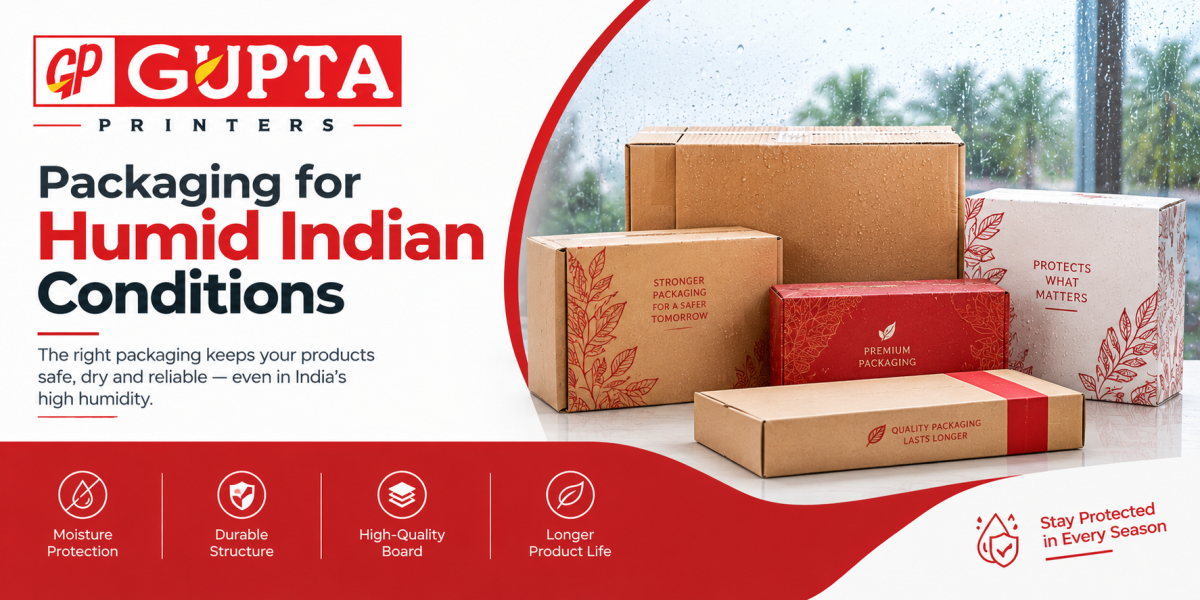
India’s diverse climate creates a unique challenge for businesses that depend on reliable packaging. High humidity, coastal air, monsoon rainfall, condensation and damp warehouse conditions can gradually affect packaging performance even when cartons appear strong at the time of packing. During monsoon transportation, additional exposure to rainwater, wet loading areas and poorly protected vehicles can increase the risk.
This is why businesses should work with a corrugated box manufacturer that understands not only box dimensions and printing requirements, but also product weight, stacking conditions, storage duration and transportation exposure.
How Humidity Affects Corrugated and Cardboard Packaging
Corrugated and cardboard packaging are engineered from paper-based materials. Their performance depends on the strength and condition of the liners, fluting and overall board construction. In a dry environment, a properly specified carton can provide excellent structural performance. However, prolonged exposure to high relative humidity can change how the paper fibres behave.
Moisture absorption can reduce board stiffness and gradually affect box strength. When cartons are stacked for extended periods, weakened boards may start to buckle, sag or deform. The problem can become more significant when heavy products are placed in upper or lower layers.
For businesses using corrugated boxes or cardboard boxes, the risk is not simply that the outer surface becomes damp. The more important concern is the gradual loss of structural performance.
A moisture-affected carton may experience:
- Reduced compression and stacking strength
- Softened or weakened liners
- Flute deformation
- Bulging sides
- Sagging top panels
- Damaged corners and edges
- Joint or seam failure
- Greater risk of product damage
Therefore, moisture resistant packaging should be considered according to the actual environment rather than treated as a universal requirement.
Why Box Strength Matters During Humid Storage and Transit
The strength required from a carton depends on more than the product’s weight. Procurement teams should consider the complete journey of the package. Important factors include:
- Product weight
- Box dimensions
- Flute type
- Liner GSM
- Single-wall or multi-wall construction
- Number of cartons stacked
- Storage duration
- Transportation distance
- Handling frequency
- Expected humidity and moisture exposure
For example, a lightweight retail carton may not require the same construction as a heavy-duty transit packaging carton travelling hundreds of kilometres through humid regions. Similarly, an electronics package requiring internal protection may need a different combination of board construction and inserts than a garment box.
A reliable packaging box manufacturer should therefore start with the application rather than simply recommending the same specification for every product.
How Humidity Affects Warehousing and Transportation
Packaging can face several moisture-related risks before the product even reaches transportation.
i) Humid Warehouses
Poor ventilation, condensation, damp floors and prolonged storage can expose cartons to high humidity. Storing cartons directly on the floor can increase the risk of moisture transfer, particularly in warehouses affected by rainwater or cleaning activities.
Cartons should preferably be stored on pallets or raised platforms, away from damp walls and areas vulnerable to water ingress.
ii) Monsoon Loading and Unloading
During India’s monsoon season, packaging can encounter rainwater during loading and unloading. Even short exposure can affect vulnerable cartons, particularly when shipments are handled in open yards or inadequately covered loading areas.
This makes monsoon packaging particularly important for businesses transporting products during prolonged rainy periods.
iii) Long-Distance Transportation
A shipment may pass through several climatic conditions before reaching its destination. A carton packed in a relatively dry facility may later encounter coastal humidity, overnight storage, rain exposure and repeated loading and unloading.
This is why packaging for transportation should consider the entire logistics journey rather than only the packing environment.
When Is Moisture-Resistant Packaging Required?
Not every shipment needs highly moisture-resistant construction. However, additional protection becomes more relevant when products face prolonged humidity, rain exposure or extended storage. Businesses should evaluate moisture resistant boxes when:
- Products are sensitive to moisture
- Cartons will be stored for long periods
- Shipments travel during monsoon months
- Warehouses have high humidity
- Products are transported through coastal regions
- There is a risk of condensation
- Packaging appearance is commercially important
- Goods travel through multiple logistics hubs
- Export shipments require extended transit periods
Depending on the application, moisture resistant cardboard boxes may involve appropriate board selection, protective finishes, lamination or secondary protective layers.
However, moisture protection should be designed around the product and exposure level. Adding unnecessary layers can increase packaging cost without solving the actual problem.
Choosing the Right Packaging Material and Construction
The first step in humid weather packaging is understanding what the package needs to withstand.
A procurement team should provide the packaging material supplier with details such as product weight, dimensions, stacking height, storage duration, expected transit route and environmental conditions.
Select the Appropriate Flute
Flute selection directly affects carton performance. Gupta Printers explains that E-flute and B-flute serve different packaging requirements, with the choice depending on product weight, printing requirements, structural needs and transit conditions.
E-flute can be suitable for compact retail packaging where print quality and a neat finish are important. B-flute can provide greater structural suitability for many transit applications. Heavier or more demanding applications may require stronger or combined board constructions.
The objective is not to choose the thickest box. It is to choose the right construction for the actual supply-chain load.
Consider Protective Finishes
Lamination and other finishing options can be useful when surface protection and moisture exposure are concerns. Gupta Printers offers in-house lamination along with corrugation, die-cutting, window patching, UV drip-off printing and other finishing capabilities.
These options can form part of custom packaging solutions when the product requires additional surface protection or premium presentation.
Industry-Specific Packaging Considerations
Different products experience different humidity risks. The packaging specification should therefore reflect the product category.
Food and FMCG
Food packaging may encounter condensation, grease, humidity and temperature changes. Products such as sweets, cakes, pizza and ice cream require packaging that balances structural integrity, hygiene and presentation.
Gupta Printers manufactures specialised food packaging including sweet boxes, cake and pastry boxes, ice cream boxes and pizza boxes.
For suitable applications, moisture resistant packaging can help reduce the impact of external environmental exposure.
Garments and Textiles
Garments can be affected by dampness, odour, staining and poor presentation. A deformed or damp carton can compromise the perceived quality of the product even when the garment itself remains usable.
Saree boxes, shirt boxes and innerwear packaging therefore need suitable structural and surface specifications, particularly when stored or transported through humid regions.
Pharmaceuticals
Pharmaceutical packaging requires consistent dimensions, clean printing and reliable carton integrity. Procurement teams should evaluate storage conditions and transportation exposure before deciding whether additional moisture protection is appropriate.
The packaging should also be specified according to the applicable product and regulatory requirements rather than relying solely on general cardboard boxes.
Cosmetics
Cosmetic packaging has both protective and presentation responsibilities. Humidity can affect the appearance of printed surfaces and contribute to box deformation during storage.
Lamination, suitable board construction and appropriate finishing can be considered as part of protective packaging where the application requires it. Gupta Printers offers cosmetic packaging with custom finishing capabilities.
Electronics
Electronics require protection from both physical handling and environmental exposure. Packaging should control product movement, provide sufficient structural protection and consider the moisture sensitivity of the product.
Gupta Printers offers customised electronics packaging with options including lamination, UV coating, varnish and other finishing treatments.
Warehouse Practices to Prevent Packaging Failure
Even the best-designed packaging can underperform when stored incorrectly. Businesses should:
- Store cartons on pallets, away from floors, damp walls and water sources.
- Ensure good ventilation and keep storage areas clean and dry.
- Protect unused cartons from rain, moisture and excessive humidity.
- Maintain safe stacking heights and inspect cartons for dampness or deformation before use.
- Minimise moisture exposure during loading and unloading, using protective wrapping when required.
These practices help preserve the intended performance of moisture resistant boxes and standard cartons alike.
How Packaging Helps Products Survive the Supply Chain
Effective packaging does more than hold a product. It creates a protective system around the product throughout its journey.
- First, appropriate construction helps maintain box strength during stacking.
- Second, correctly sized cartons reduce unnecessary product movement.
- Third, suitable protective layers can help limit environmental exposure.
- Fourth, stronger transit packaging can reduce the likelihood of deformation during handling and transportation.
This becomes particularly important for businesses shipping products across India, where a single supply chain can involve humid warehouses, monsoon roads, multiple distribution centres and extended storage.
The right packaging for transportation therefore helps businesses reduce avoidable product damage, repacking requirements, shipment rejection and customer complaints.
Humid-Weather Packaging Checklist for Procurement Teams
Before ordering packaging, procurement teams should ask:
5 Key Packaging Considerations
- Climate & Transit Exposure: Assess humidity levels, monsoon travel, transportation distance and expected storage duration.
- Product & Load Requirements: Consider product weight, stacking height and the required box strength for safe handling.
- Board Construction: Select the appropriate flute, liner GSM and board structure based on the product and transit conditions.
- Moisture Protection: Determine whether humidity resistant packaging, lamination, inner liners or additional protective layers are necessary.
- Storage & Quality Checks: Plan proper pre-dispatch storage and request packaging samples to verify fit, strength and suitability before bulk production.
A detailed specification helps the corrugated box manufacturer understand the actual application and recommend a practical solution instead of relying on a standard carton.
Why Choose Gupta Printers for Humid-Weather Packaging?
Choosing a packaging supplier is ultimately about manufacturing capability, specification knowledge and consistency.
Gupta Printers has been manufacturing packaging solutions in Sivakasi since 1950 and states that it has more than 75 years of experience and 2,000+ completed projects. Our in-house capabilities include
- Corrugation
- Board pasting
- Lamination
- Die-cutting
- Window patching
- UV drip-off printing and other finishing processes.
This breadth allows businesses to discuss packaging requirements based on the actual product, storage environment, transportation conditions and brand requirements.
For businesses looking for a packaging box manufacturer, the objective should not simply be to find the lowest per-unit price. The better approach is to evaluate whether the packaging specification can protect the product throughout its intended supply chain.
Get a Custom Packaging Quote
Don’t let humidity, monsoon exposure or poor storage compromise your products after they leave your facility.
Contact The Gupta Printers to discuss and request a tailored packaging quote.
FAQs
- Does humidity weaken corrugated boxes?
Yes. Prolonged exposure to high humidity can increase moisture absorption in paper-based boards, potentially reducing stiffness, compression performance and stacking stability.
- When should businesses consider moisture resistant packaging?
It is worth evaluating when products face prolonged humidity, monsoon transportation, damp warehouses, coastal conditions, condensation or extended storage.
- Are thicker cardboard boxes always better for humid conditions?
Not necessarily. Performance depends on board construction, liner GSM, flute selection, box dimensions, product weight, stacking conditions and moisture exposure.
- How should corrugated boxes be stored during the monsoon?
Keep cartons elevated from the floor, away from damp walls and rainwater, and store them in a clean, dry and adequately ventilated area.
- Can Gupta Printers provide customised packaging for different industries?
Yes. Gupta Printers provides customised packaging across food, garments, pharmaceuticals, cosmetics, electronics and other sectors, with in-house manufacturing and finishing capabilities.