
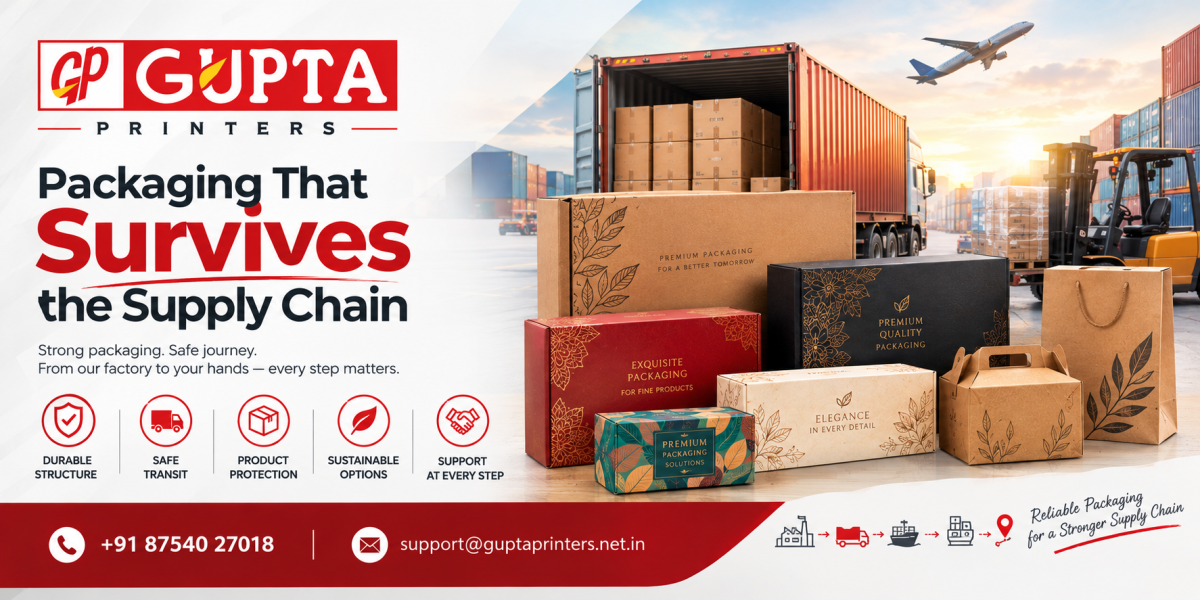
Packaging has one job that matters before anything else: it must survive the journey. A box may look attractive when it leaves the manufacturing facility, but its real performance is tested when it is stacked in a warehouse, loaded onto a truck, exposed to vibration, handled multiple times and finally delivered to the customer.
For manufacturers, exporters, retailers, e-commerce businesses and procurement teams, choosing a reliable corrugated box manufacturer is therefore more than a purchasing decision. The right packaging can reduce product damage, improve warehouse handling, control transportation costs and protect the brand throughout the supply chain.
Why Packaging Must Survive the Supply Chain, Not Just Look Good
A product can pass through several physical environments before reaching its final customer. During this journey, packaging can experience compression, vibration, impact, stacking pressure, repeated handling and moisture exposure.
A poorly specified box may collapse under warehouse loads, become distorted during transportation or leave excessive movement around the product. In some cases, the packaging itself may become the reason for product damage.
This is why businesses should evaluate corrugated boxes according to their actual supply-chain conditions rather than selecting packaging based only on appearance or unit price.
Effective protective packaging should provide a practical balance between product safety, structural performance, dimensions, handling convenience and transportation efficiency.
Where Packaging Faces the Most Supply-Chain Stress
Compression and Stacking
Boxes stored in warehouses or transported on pallets can carry the weight of multiple cartons above them. If the construction is not appropriate, the lower cartons may gradually lose their shape.
This makes box stacking strength an important consideration for businesses handling bulk shipments. The expected stacking height, product weight, storage duration and box construction should all be considered before finalising specifications.
Vibration and Repeated Handling
Transportation involves continuous movement. Trucks, containers and delivery vehicles expose packages to vibration, sudden movement and repeated loading and unloading.
A properly designed shipping box should therefore minimise unnecessary product movement while maintaining its structural integrity during handling.
Moisture and Environmental Exposure
Moisture can weaken paper-based packaging and affect its performance, particularly during long-distance transportation, storage or humid operating conditions.
For products exposed to such environments, businesses may need moisture-resistant packaging or suitable protective layers depending on the application.
Long-Distance Transportation
Long-distance logistics increases the number of handling points and the duration for which packaging must remain functional. This makes packaging for transportation a different consideration from packaging designed only for short-distance retail movement.
The further a product travels, the more important it becomes to match the packaging specification with the expected logistics environment.
What Determines Box Strength and Packaging Durability?
A box’s performance does not depend on one specification alone. Material, GSM, ply, flute, dimensions, construction and product weight work together to determine the final performance.
Material and GSM
GSM refers to the weight of paper per square metre. While GSM is an important specification, higher GSM should not automatically be treated as better.
The correct material specification depends on the product, box structure, transportation conditions and required protection. A reliable cardboard box manufacturer should help buyers select material according to the application rather than simply recommending the heaviest available board.
Ply and Flute
Ply refers to the number of paper layers used in a corrugated construction, while flute describes the shape and profile of the corrugated medium.
Different flute constructions can provide different combinations of cushioning, rigidity, printability and structural performance. Single-wall, double-wall and other constructions can also be selected according to load and handling requirements.
For this reason, box strength should always be evaluated against the actual journey the packaging must survive.
Box Dimensions
Dimensions can have a major effect on packaging performance.
An oversized box creates excessive empty space, allowing the product to move inside. It may also require more protective filler and increase dimensional weight during transportation.
An undersized box can create compression on the product, make packing difficult and place additional stress on the box walls.
The ideal packaging provides sufficient clearance for protection without allowing excessive movement. Gupta Printers’ packaging guidance also emphasises matching box sizing and specifications to the product and application.
Construction and Closure
The way a box is cut, folded, joined and closed also influences performance. Die-cut structures, folds, seams, windows and closures should be considered according to the intended use.
This is particularly important when ordering custom boxes, because the structure should be developed around the product rather than forcing the product into an existing standard format.
How Should Packaging Be Selected for Long-Distance Transportation?
When selecting transit packaging, businesses should begin with the product rather than the box. Ask:
- How much does the product weigh?
- Is it fragile, flexible or rigid?
- How many cartons will be stacked?
- How long will the product remain in storage?
- Will it travel by road, rail, air or sea?
- Could it encounter moisture?
- How many loading and unloading points are expected?
- Does the product need internal cushioning?
- Is the packaging being used for domestic or export distribution?
These questions help determine whether standard packaging is adequate or whether custom packaging solutions are required.
A manufacturer should also review the product dimensions carefully. Properly designed packaging boxes can reduce movement, improve pallet utilisation and minimise unnecessary material usage.
Why Oversized and Undersized Boxes Can Increase Costs
An oversized carton may require additional filler material while occupying more storage and vehicle space. If transportation charges are influenced by dimensional weight, excessive carton volume can also increase freight costs.
On the other hand, an undersized box can create compression and handling problems, increasing the possibility of damaged products.
This is why a packaging box manufacturer should consider both protection and logistics when developing a box. The objective is not simply to produce the smallest or strongest carton, but to create the most appropriate structure for the product and supply chain.
Industry-Specific Packaging Requirements
Different industries place different demands on packaging.
i) Food
Food packaging may face handling, moisture and temperature-related challenges. Boxes for cakes, sweets, pizza and other food applications need appropriate construction and material selection.
ii) Garments and Sarees
Garments require protection from dust, handling and external wear while maintaining attractive presentation. Gupta Printers manufactures saree boxes and other garment packaging, with custom sizing, printing and window options. Its saree packaging page also describes a four-step quality verification process.
For textile businesses, a suitable cardboard box manufacturer should balance structural protection with presentation and branding requirements.
iii) Cosmetics
Cosmetic packaging often needs a combination of product protection, attractive printing and retail presentation. Depending on the product, custom boxes can be designed around individual dimensions and branding requirements.
iv) Electronics
Electronics can require additional protection against movement and handling stress. Box dimensions, internal protection and structural construction become particularly important when products pass through multiple distribution points.
v) Pharmaceuticals
Pharmaceutical packaging demands consistency and dependable construction because damaged cartons can affect product handling and distribution. Packaging specifications should therefore be selected carefully according to the product and supply-chain requirements.
Gupta Printers’ portfolio covers packaging applications across garments, food, pharmaceuticals, electronics, cosmetics, confectionery and other industries.
Why Choose Gupta Printers for Custom Packaging?
Selecting a corrugated box manufacturer with manufacturing experience can make specification, production and quality control easier for bulk buyers.
Gupta Printers has more than 75 years of manufacturing experience, with its packaging operations established in 1950. We offer custom packaging solutions with options for size, shape, colour, artwork and finishing..
Quality consistency is particularly important for bulk procurement. We state that bulk orders undergo a three-stage quality process covering raw material inspection, in-process monitoring and final verification before dispatch.
Businesses looking for corrugated boxes, cardboard boxes or application-specific packaging can therefore discuss their product dimensions, quantity, design and performance requirements before production.
Practical Packaging Selection Checklist
Before finalising your packaging supplier, ask:
- Check material, GSM, ply and flute based on product weight and application.
- Verify box dimensions and customisation for a precise product fit.
- Consider stacking, moisture and transportation conditions before selection.
- Ask for production samples and bulk-order quality checks before approval.
- Confirm printing, finishing and storage optimisation with the manufacturer.
A supplier that can answer these questions clearly is more likely to function as a packaging partner rather than simply a box vendor.
Get Custom Packaging Quote
Your packaging should do more than carry your product, it should protect it through every stage of the supply chain.
Whether you need shipping boxes, garment packaging, food cartons, electronics packaging or specialised industrial packaging, Gupta Printers can develop custom packaging solutions around your product, quantity, design and transportation requirements.
Looking for reliable packaging for your bulk orders? Partner with The Gupta Printers for customised, supply-chain-ready packaging solutions.
FAQs
1) What makes packaging strong enough for transportation?
Packaging strength depends on material, GSM, ply, flute, dimensions, construction, product weight, stacking conditions and transportation environment. The correct specification should be selected according to the complete supply-chain journey.
2) How do you prevent box damage during shipping?
Use appropriately specified materials, correct box dimensions, suitable structural construction and adequate internal protection. Avoid excessive empty space and ensure the box is designed for expected stacking and handling conditions.
3) What factors affect packaging strength?
Material quality, GSM, ply, flute, box dimensions, construction, closure method, product weight, stacking height and environmental exposure can all affect performance.
4) How should packaging be selected for long-distance transportation?
Evaluate product weight, fragility, transportation mode, stacking conditions, moisture exposure, handling frequency and journey duration. These factors help determine the appropriate packaging for transportation.
5) Why should businesses work with a packaging manufacturer?
A manufacturer can help businesses develop specifications around product dimensions, materials, construction, printing and production requirements. This can be particularly valuable for businesses purchasing packaging in bulk.
